STEM and the Trails of History

Info about programs on the Trails of History this weekend can be found in the "About Us" section on the right side of your screen.

Earlier this week, a great bunch of people gathered at the Pennsylvania Military Museum (thank you for hosting!) to explore Science, Technology, Engineering and Math (STEM) education as it relates to the work that museums and historic sites do. Thanks to Rhonda Newton of the Pennsylvania Heritage Foundation, the program included Sally Flaherty and David Bauman, curriculum advisors (Social Studies and Science Education, respectively) from the Pennsylvania Department of Education (PDE), as well as Jill Whelan from Conner Prairie Interactive History Park (via Skype).
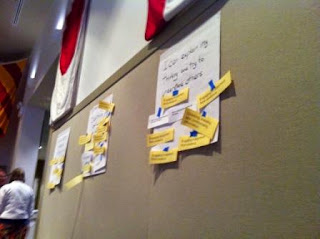
STEM_workshop_at_Military_Museum_August_2014
Connecting science, math, and history standards (photos by AKF)
Staff from all over the Trails of History participated in discussions about STEM and how much of what they already do in their programming touches on these disciplines. Flaherty and Bauman shared with us PDE's working definition: "STEM education is an intentional, integrative approach to teaching and learning in science, technology, engineering, and mathematics. Students become adept problem solvers, innovators, and inventors who are self-reliant by asking questions, investigating, making informed decisions about how they live their daily lives and engage in their vocations and communities." They also walked us through an exercise that showed the connections between academic standards for scientific and mathemtatics practice and academic standards for history, in terms of the kinds of intellectual frameworks and activities that engage students.

It struck me that "integrative approach to teaching" and "asking questions, investigating" also describe the best ways that museums and historic sites help students (of all ages) learn about the past and how it relates to their lives. Hmmmm.

Skyping_with_Conner_Prairie
Skyping with Jill Whelan at Conner Prairie
Whelan shared with us a bit about her experience working with front-line staff at Conner Prairie to help them be more comfortable talking with visitors about STEM. She also created a sample matrix that can be used to articulate the STEM concepts that are embedded in so many educational components and public programs at our historic sites, from cooking and food preservation, to gardening, to clothing, to transportation, to...you get my point.

Small_group_discussions_at_STEM_workshop
Small group discussions
Perhaps the best part of the day (shhh, don't tell our bosses) was the small group and large group discussion at the end of the day, where long-time and newer colleagues talked about how to apply what we heard and about what we, as a group, can do next. It has been quite a while since we got this bunch together and it was invigorating to see the possibilities for sharing expertise across sites. Stay tuned.

A Mid-August Roundup

Looking for something to do this weekend? A link to the August program listings is in the right hand navigation, under "About Us" (or you can click on "August program listings" in this sentence).


Log_Farm_at_Landis_Valley_August_2014
Log Farm and Garden, Aug. 7, 2014, via Landis Valley's Facebook page
Thank you to Caroline Briselli for last Friday's post about her internship in Collections Management and to Jake Coen for his Wednesday post about interning in the Pennsylvania State Archives. For more info on summer internships on the Trails of History, check out Chronicle Ephrata or the Pennsylvania Historic Preservation blog.

While pulling together some links for coverage of the Pennsylvania Military Museum's Boot Camp for Kids earlier this month (photos are on Facebook), I noticed that one young man, 12-year-old Jake Tanner, was quoted in both a Centre Daily Times article and on the "We Are Central PA" website. He is apparently a repeat participant and provides a great (unrehearsed, we swear) testimonial for the program. He's quoted on the website as saying, "It's really fun because you get to interact with real veterans, too." The CDT article includes this: "You support the museum. That's probably most important because it does a lot for the community and lets us be in this event. I think it's a way to give back to teach us stuff like this." Jake, you warm my heart.

The Pennsylvania Lumber Museum is mentioned in a PennLive article about scenic views throughout Pennsylvania. The article includes the museum as an attraction nearby the ruins of Austin Dam, in Potter County.

Today (Aug. 15) is the last day to register for discounted admission and model railroading clinics planned for the Railroad Museum of Pennsylvania's Model Railroading Day on Sept. 6. Space is limited. National Model Railroad Association, Susquehanna Division, is handling registrations.

The organizers of the Drake Well Marathon are hoping to provide a larger crowd this year to cheer on the runners and encourage them on their 26-mile trek from Drake Well Museum through Titusville to the finish line. If you can head out this Sunday, you can help make Titusville a bigger event for the marathoners and encourage more to participate next year. And speaking of Drake Well, this item reaches way back into June (I finally waded through my Google Alerts). Congratulations are due to Melissa Mann, site administrator, who was recognized with the Samuel T. Pees Keeper of the Flame award by the Petroleum History Institute for her work at Drake Well and, previously, with Oil 150 and the Oil Region Alliance.

Congratulations to the Erie Maritime Museum and US Brig Niagara! The Flagship Niagara League's participation in Erie Gives Day on Tuesday garnered more than $12,500 to support the ship and its programs (and that's before their share of the matching funds). Voting for Erie's Choice Museum is open until August 31, and Erie Maritime Museum is one of the nominees. Vote early, vote often!

Interns onboard for archival road trip

Today's guest blogger is Jake Coen, who has spent this summer as a PHMC Keystone Intern assigned to the Pennsylvania State Archives. A lifelong Harrisburg resident, Jake will return this fall to Providence College, in Rhode Island, where he majors in history. Thanks, Jake.

State_Archives_Tower_Harrisburg
Pennsylvania State Archives Tower, Harrisburg
       On July 28, the interns at the Pennsylvania State Archives took a field trip to Carlisle to visit three other document and artifact repositories.  While the State Archives contains artifacts ranging from railroad engineering drawings to a few locks of Thomas Jefferson’s hair, the visit to Carlisle proved to be an eye-opening experience. 
            
      The first stop on the Carlisle trip was to the Army Heritage and Education Center.  This massive federal complex boasts a museum of American military history, a series of outdoor interactive exhibits and reconstructions, an impressive archive and artifact repository and two state-of-the-art conservation labs.  Needless to say, it was a very impressive experience!  Interns were treated to a private tour of the museum that pointed out not only the major artifacts on display and interactive experience, but also drew attention to the planning and construction of exhibits.  After a walk through the conservation labs and artifact repository, the head of the archives gave the interns a once-in-a-lifetime opportunity to see (and touch!) some priceless documents, including a letter written by Robert E. Lee during his retreat from Gettysburg and the transcript from the telephone room at Pearl Harbor on the day of the Japanese bombardment. 
         
       Across town, the Dickinson College archives and special collection opened its doors for the Keystone Interns to explore its collection of rare books, school records, historical documents of local importance and some private papers of some of the college’s most notable alumni, including President James Buchanan.  In addition, the interns enjoyed several special exhibits assembled by Dickinson College interns.  These exhibits used items from the special collection, notably a selection of artifacts and oddities collected from around the world by Dickinson alumni, and an impressive collection of tools used by Joseph Priestley, the 18th-century scientist responsible for the discovery of oxygen. [Editor's note: Dr. Priestley's American home and laboratory in Northumberland is part of the Pennsylvania Trails of History.]
            
    The last stop was the Cumberland County Historical Society, a privately owned and operated museum, library and archive.  During a private tour around the museum and collections, the interns discussed the challenges and rewards of maintaining a private archive and museum as well as some of the technological and outreach-based programs used by the society to preserve its records and to reach a wider audience. 
            
      While it may seem like one museum or one archive may have it all when it comes to a certain topic or field of interest, the State Archives intern field trip to Carlisle demonstrates that this is simply not true.  Each repository and museum offers its own unique and exciting collections that are arranged and cared for in a variety of ways.  Whether holding soldiers’ journals, a collection of 16th-century books, or a variety of maps and charts of a particular region, the three archives visited by the interns presented a different set of records that, when looked at as a whole, complemented each other to form a much fuller picture than any single institution could do on its own.