With the impending weather (as I write this it's too soon to tell what will be happening in PA), please check ahead before heading out for Trails of History events this weekend. Stay safe.
Today's guest post comes from Christina M. Stetler, membership and annual giving coordinator for the Pennsylvania Heritage Foundation. Chris began researching the 1918 influenza pandemic while on staff at the Pennsylvania State Archives and was responsible for creating the Archives Research Guide on the subject. She also wrote a longer article, "The 1918 Spanish Influenza: Three Months of Horror in Philadelphia," which appears in the Autumn 2017 (Volume 84, No. 4) issue of Pennsylvania History, the journal of the Pennsylvania Historical Association. EDITOR'S NOTE/UPDATED INFO: The Fall 2018 issue of Pennsylvania Heritage includes "1918's Deadliest Killer: The Flu Pandemic Hits Pennsylvania," by Thomas J. McGuire.
For information on the 2018-19 flu season, including vaccination options, visit the influenza page on the PA Department of Health's website. This has been a public service announcement.
 |
| Members of Co. K, 110th Regiment Infantry, passing through town captured by their comrades. Varennes-en-Argonne, Meuse, France. Sept. 26, 1918 (PA State Archives, MG-156 - Edward Martin Papers, 1866-1967) |
In the fall of 1918, the war to end all wars raged in Europe. The United States, having joined the war in 1917, hoped their entrance would bring a swift conclusion to a battle-worn Europe. The war would end in November 1918, but not before death encircled the globe.
Medical professionals in the spring of 1918 recorded an unusual flu season. Doctors in Haskill, Kansas, noted an uptick in cases with symptoms unlike the typical flu season, though there were not an abnormal number of deaths. A doctor in Kansas mailed his notes to the Board of Health in Washington, D.C., which indicated he was concerned with what he saw. This act itself was uncommon, as influenza was not a mandatory reportable disease at the time.
Cases of influenza were few during the months of June, July, and early August. By the end of August, however, the influenza virus from the spring had returned, but more virulent and deadly.
The first indication of the coming calamity came from the Boston Naval Yard. In late August, men began going to the naval hospital complaining of illness. A few at a time, then a steady stream. So many coming in daily, that tents were set up to accommodate the ill. The war effort continued, however, and ships left the Boston Navy Yard for other American and European ports. One such vessel sailed to the Philadelphia Navy Yard, arriving on September 6. This ship carried the influenza virus into Philadelphia, leading to the deadliest outbreak of any U.S. city.
Once docked in Philadelphia, several sailors went immediately to the Naval Hospital complaining of flu symptoms. As in Boston, as the days went on, more sailors started developing symptoms and needing medical assistance. According to the
Philadelphia Evening Bulletin, on September 19, three sailors from the Navy Hospital passed away from the virus: James J. Keegan, Storekeeper 1st Class; Richard Singleton, Chief Boatswain’s Mate; and Mark J. Harrison, Fireman 1st Class. On the date of publication, there were 565 total cases of influenza at the Navy Yard and the 4th Naval District, with 136 cases presenting the previous day.
 |
James J. Keegan death certificate (Pennsylvania (State). Death certificates, 1906–1963. Series 11.90 (1,905 cartons). Records of the Pennsylvania Department of Health, Record Group 11. PHMC/PA State Archives)
|
Cases of the virus spread to the rest of the city with civilian employees who worked at the Navy Yard. Though there were approximately 150 influenza cases outside the Navy Yard in mid-September, the Director of Public Health and Charities, Dr. William Krusen, believed the virus could be contained with normal precautions.
Shortly after the first deaths attributed to the outbreak were recorded, the Board of Health required influenza to be a reportable disease. Doctors were now required to report cases and isolate patients to try to curb the spread of the disease. Initially, this was to be only a temporary measure, but the requirement to report influenza cases continues to this day.
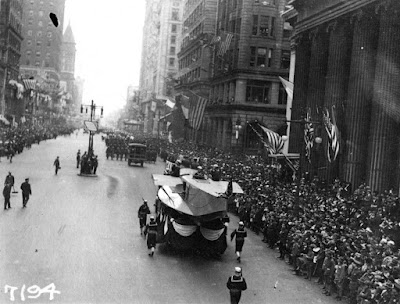 |
| Liberty Loan Parade at Philadelphia, Pennsylvania, 28 September 1918 (U.S. Naval History and Heritage Command NH41730) |
On September 28, 1918, Philadelphia put aside its concern with the influenza virus to support the Fourth Liberty Loan parade. In the previous three parades, Philadelphia had exceeded goals for support of the war effort and nothing would stop the city from kicking off the Fourth Liberty Loan drive.
This would be disastrous to the city and its citizens. Within days, the number of ill jumped to 635 new cases, with more being reported hourly. The city needed to take strong measures to curb the disease and on Thursday, October 3, the Philadelphia Board of Health closed all public schools and canceled all outdoor Liberty Loan meetings. [Editor's note: "
Parade to Raise Money for World War I Brought Deadly Influenza to Williams Valley in 1918," on the Wynning History blog, explores a similar situation in a smaller Pennsylvania community.]
With the number of ill and dead mounting, the Board of Health also closed all saloons, theaters, and churches.
There's more to the story (
read it here).
The week ahead (9/14-20)...
Bushy Run Battlefield
Sept. 19: History Speaks Series—Dana Knezevich, author of
Life of Eastern Woodland Indians, will present “The Making of Native American Clothing” (
program description is on the website). Cost is $8 in advance, $10 at the door (members get a 10% discount). Contact
secretary@bushyrunbattlefield.com or Bushy Run Battlefield at 724-527-5584 for advance tickets.
Drake Well Museum and Park
Sept. 15: Fall Gas Up—the museum hosts the Pioneer Steam and Gas Engine Society's display of antique gas engines, oil field and farm equipment, and more. Included in regular admission. 9 am-3 pm.
Erie Maritime Museum and U.S. Brig Niagara
Sept. 20: Erie Yacht Club Happy Hour—the
Lettie G. Howard will be at the Erie Yacht Club for a special dockside happy hour. The event is open to the public.
Check the website for updated info.
Graeme Park
Sept. 16: Living History Sunday—today's event explores the struggle Pennsylvania’s Quaker families faced during the Civil War and the impact the war had on farms like Graeme Park. Admission charged. Noon-3 pm; presentation at 2 pm, tours of the Keith House available during the afternoon.
Sept. 20: Happy Hour with the Historian—Dr. Stephen Griffith will explore the history of theater production in colonial Philadelphia from the establishment of Pennsylvania in 1681 to 1800 (
more details on the website). Cost to attend is $5 (free for members). Munchies and wine/beer available for purchase starting at 6 pm; lecture begins at 7.
Hope Lodge
Sept. 16: Site open—enjoy the grounds and take a guided tour of the mansion. Admission charged. 1-4 pm (tours at 1:00 and 2:30 pm).
Landis Valley Village and Farm Museum
Sept. 15: Wool Frolic and Yarn Sale—celebrate the fiber arts and the people, plants, and animals that make them possible. Enjoy activities for the kids and
shop for deals on yarn, patterns, and paraphernalia. New this year - did you know that sheepdogs practice herding sheep by herding ducks? I didn't either, but now I do. You can give it a try. Admission charged. 10 am-4 pm.
Old Economy Village
Sept. 15: Gardening class—"Next Year's Garden," presented by master gardener Cynthia Pagesh, will teach you how to help this year's garden become next year's garden through seed saving and cuttings (
more info on Facebook event page). Call David Miller at (724)266-4500 ext.110 for details. 10 am-1 pm.
Pennsbury Manor
Sept. 16: Special programming—
Open Hearth Cooking features the bake oven today. Included in regular admission. 1-4 pm.
Pennsylvania Lumber Museum
CORRECTION Sept. 15 22: "3rd" Weekend Program—"Voices of Pine Creek" is an oral history presentation (two documentaries) exploring life in the region through the experiences of local residents. Together the two films run about one hour and 20 minutes. Attendees will also get a sneak peek at the Webber Cabin, home to Bob and Dotty Webber for many years; Bob Webber is among the oral historians featured in "Voices of Pine Creek." 1 pm.
Pennsylvania Military Museum
Sept. 19: Civil War Lecture—William C. Davis, retired history professor and executive director of the Virginia Center for Civil War Studies at Virginia Tech, will present "Looking for Loreta--the Confederate Kardashian." Davis's talk, sponsored by the Civil War Era Center at Penn State, focuses on Loreta Velazquez, who allegedly disguised herself as a man to fight and and served as a Confederate spy during the Civil War. 7-8 pm.
State Museum of Pennsylvania
Please
check the Planetarium page for program schedule.
Sept. 14: Learn at Lunchtime—author and photographer Tim Palmer will present "Twilight of the Hemlocks and Beeches," based on his book of the same title (
more info). Included in general admission. 12:15 pm.
Sept. 16: Archaeology at Fort Hunter—Section of Archaeology staff and volunteers will be on hand for Fort Hunter Day to share their info with the public. This season's Fort Hunter excavations started Sept 5 and will continue on weekdays into October (
see museum website for schedule details).


 Posts

