Showing posts with label religion. Show all posts

Wrapping Up the Month of June

Please check the June program page for info on virtual programs happening this weekend, including Pennsbury Manor's online version of their popular Brews & Bites food and beverage event. The July program page is also available, with a preview of online programs, including virtual summer camp programs at Erie Maritime Museum and the Railroad Museum of Pennsylvania. Looking for other at-home activities? Visit the Trailheads Rec Room for ideas (links are to the right of your screen).

Most of frame is two-story brick manor house, white fence and two white-sided smaller buildings are seen to right of frame
The Manor House at Pennsbury (left) with outbuildings (photo via Facebook, credit Leah Jeffers)
Last Friday's post shared info on numerous programs and activities scheduled to mark Juneteenth 2020. Pennsbury Manor partnered with the African American Museum of Bucks County to present an online program focused on the history of Juneteenth, the Emancipation Proclamation, and interpreting the stories of enslaved people at Pennsbury in the 17th and 18th centuries. If you missed it, the recording is available on Pennsbury's Facebook page.

Young African American woman seated for the camera. She is wearing a blue shirt and large red earrings.
Screenshot of performer and playwright Marissa Kennedy, who explained and presented a first-person interpretation of Susannah Warder, an enslaved woman born and raised at Pennsbury during the Juneteenth virtual program.
If you're interested in learning more about the history of slavery in colonial Pennsylvania, Graeme Park shared their research in a series of posts on Friday (first post is below - check Graeme Park's Facebook page for the additional posts).


June is Pride Month, and recently the PA Trails of History Facebook page shared a 2019 post from the State Historic Preservation blog looking at the history of the Stonewall Uprising (last year was the 50th anniversary), the fight for LGBTQ+ rights in Pennsylvania, and several Pennsylvania sites associated with LGBTQ+ history (read the blog post). Readers might also be interested in a new book, Out in Central Pennsylvania: The History of an LGBTQ Community, by William Burton with Barry Loveland (our former PHMC colleague). The book was published by Penn State University Press, but check with the LGBT Center of Central PA for a copy.

Black and white photo showing wood-sided buildings - facing front is a long dormitory-type building with two storys and attic dormers. At a right angle is a smaller meeting house. Text reads Hidden Knowledge at Ephrata.
Text reads: Hidden Knowledge at Ephrata. Special thanks to Dr. Jeff Bach for his assistance in preparing this virtual exhibit (photo via Facebook)
The staff at Ephrata Cloister have launched Hidden Knowledge at Ephrata, a new virtual exhibit exploring the multifaceted religious world view of the Ephrata community. It includes numerous sources of knowledge and philosophy and shares their impact on the belief systems of the Conrad Beissel and those who followed him. You can find the exhibit on Ephrata Cloister's website (link to exhibit).

As part of their deeper dives into Harmonist history, Old Economy Village staff recently shared a series of posts exploring literary figures who wrote about the Harmonists. While first debunking an old story that Charles Dickens had visited Economy during his American travels, they shared literary works and letters from Rudyard Kipling, Lord Byron, and Nikolaus Niembsch von Strehlenau (an Austrian poet). The Dickens post is below; visit Old Economy's Facebook page to see the others.

It's Not All Fun and Games

There is a lot still to be determined about what the next months will look like on the Trails of History. Governor Wolf's phased plan to ease the stay-at-home orders officially kicks in next Friday, although some recreational and construction activities start to open up today. We'll do our best to keep you posted on site schedules. The May program page lists no programs at this point, but it does contain a full list of links to Trails of History Facebook pages so that you can continue to enjoy our online offerings and get the latest info on reopening plans.

Some Trails of History sites are participating in an event called "Giving Tuesday Now" on May 5, which is an adjunct to the annual Giving Tuesday event the Tuesday after Thanksgiving. If you're able, this might be a great time to help your favorite Trails of History site with a donation.


So you're telling me it's May already? Wild. March went on forever, but April whizzed past me. I hope everyone out there is doing okay. As we've been noting over the past weeks, sites and museums on the Trails of History have stepped up on social media to provide entertainment and behind-the-scenes experiences during this very difficult time. I've shared samples of some of those social media offerings (see last week's post, for example).

To help myself keep track and to help show how much is going on, I've created "Trailheads Rec Room," which lives on the sidebar to the right of your screen in the "About Us" section. In the Rec Room you'll find a link for "Coloring Pages and Games," one for "Crafts and Activities" (be sure to check out the Morse Code posts between Erie Maritime Museum, PA Military Museum, and Railroad Museum of PA), and a third for "Jigsaw Puzzles and BINGO." The BINGO page includes three Trails of History bingo cards that you might want to take a look at, in addition to Bushy Run Battlefield's Bingo card. In coming weeks, my plan is to add a page for "Videos and Virtual Tours."

In addition to all this, many sites have also shared posts that delved into relevant historical themes and connected to our current concerns and situations. Here are some of my favorites.

Pennsylvania Lumber Museum provided a little something for those of us who miss baseball


Joseph Priestley House helped focus attention on scientists with a series of #SundayScientist posts


Graeme Park shared info about epidemics and quarantines in colonial Philadelphia


Pennsylvania Military Museum's blog has posted lots of military history topics, including an exploration of Metallica lyrics


Pennsbury Manor provided historical insights on Passover, Easter, and Ramadan traditions


And Drake Well Museum & Park started a conversation about oil prices

So Many Ways to Learn

Please check the June program listings for events coming up.

Colorful thank you notes from third graders to PA Lumber Museum
Third graders from Otto Eldred Elementary wrote colorful thank you notes after their visit to the Pennsylvania Lumber Museum in May (courtesy PLM)
Thousands of elementary school students visit the Pennsylvania Trails of History every spring and fall, and many more visit with their families and friends throughout the year. The thank you notes pictured above, received by staff at the Pennsylvania Lumber Museum, are just a few of the hundreds sent to our staff and volunteers. Many teachers find it a great way to find out what their students remember about their visit, and we find them helpful, too. While younger students are most common for organized visits, we certainly see our share of older students and adults, eager to learn in a variety of ways.

William Penn's legacy as founder of Pennsylvania

This year to commemorate the 300th anniversary of William Penn's death, Pennsbury Manor is asking school visitors to describe Penn's legacy. They'll be sharing those insights every Wednesday. This week, they posted about Penn's role as founder of Pennsylvania, certainly a significant legacy for us all. Follow Pennsbury's Educator page on Facebook to see more on Penn's Legacy Year.

The University of Maryland's Eckley Archaeology Project has begun for this summer, with students documenting the Rubin House. Local high school students interested in archaeology may want to apply for the high school field program, which starts on June 18. More information on applying, as well as photos of numerous activities, can be found on the Eckley Archaeology Project Facebook page. Otherwise, be sure to take a look at the excavations while at Eckley Miners' Village for this summer's Molly Maguires semicentennial.

Last weekend, to help kick off the summer season, The Allegheny Ironsides vintage baseball club were on site at Historic Pithole for Wildcatter Day. They helped the Drake Well team learn how to play 1860s baseball as it would have been played during Pithole's heyday. They posted a summary and lots of photos on their Facebook page.

Ephrata Cloister staff members Michael Showalter and Nick Siegert contributed a section for the upcoming museum studies text, Interpreting Religion at Museums and Historic Sites, edited by Gretchen Buggeln and former PHMC executive director Barbara Franco. The book is part of the American Association for State and Local History's Interpreting History Series, published by Rowman & Littlefield. It is due out in September.

WBRE's Lauren Hensley recently visited Joseph Priestley House and posted about it on her Facebook page. Tomorrow, June 9, the site hosts its first World Doll Day event, dedicated to longtime volunteer Ruth Eleanor McCorkill and devoted to teaching about the Priestley family in the 18th and 19th centuries. Kids are encouraged to bring their own dolls along. The event is free, but there is a fee for the doll tea party and reservations are required.

Ruth Eleanor McCorkill with Merry Mary doll she created for Joseph Priestley House
Ruth Eleanor McCorkill (1920-2017) with Merry Mary doll she created for Joseph Priestley House (photo JPH)

The Hex Hollow Murders

Looking for events on the Trails of History - Halloween-themed or otherwise? Check out the October program page.

Today's guest post is by Corine Lehigh, an archival clerk at the PA State Archives. She is currently attending Penn State Harrisburg for her graduate degree in American Studies. Corine has contributed to Trailheads several times, including her first post as an Archives intern. Please note that there is some slightly graphic historical description below - don't say you weren't warned!


Powwowing, or brauche in the Pennsylvania Dutch dialect, is a magico-religious practice whose chief purpose is the healing of physical ailments in humans and animals. It has had other aims as well, such as conferring protection from physical or spiritual harm, bringing good luck, and revealing hidden information. Powwowing has been practiced in Pennsylvania since the first German-speaking Protestant settlers arrived in the 18th century. Prior to the late 20th century, powwowing was practiced routinely by the descendants of these European settlers.

Don Yoder, a recognized expert on Pennsylvania German folklore and customs, considered powwowing to be based on ancient religious healing traditions sanctioned by the Roman Catholic Church. It was driven underground among Protestant populations, such as the Pennsylvania Dutch, and placed into the hands of lay practitioners. Its more direct antecedent was the book The Long Lost Friend, written in 1820 by Berks County healer John George Hohman. Eight to twelve powwow practitioners still live and work in south central PA today. Powwowing rituals involve the use of one or more acts, varying between incantations, gestures and body position, and manipulation of physical objects. Modern powwowers have their recipes committed to memory and none of them use any of the charm books historically employed by powwowers, such as The Sixth and Seventh Book of Moses, Egyptian Secrets, or The Long Lost Friend.

Nelson Rehmeyer, of York County, was an alleged powwower in the 1920s. His neighbor John Blymire reportedly had a run of bad luck, including losing his job. Blymire consulted the local river witch, another powwower named Nellie Noll. Nellie told Blymire that his bad luck was due to a hex that Rehmeyer had put on him. Nellie told Blymire that he needed to steal Rehmeyer’s spell book, along with a lock of his hair, and bury both 6 feet underground. On Nov. 28, 1928, Blymire and two local accomplices went to Rehmeyer’s house to retrieve the items. Rehmeyer confronted them. Blymire and the two local boys tied Rehmeyer up, beat him, and strangled him to death. They then set his body on fire. The house withstood the fire, which was put out by heavy rainfall that day. However, the spot where Rehmeyer’s body burned left a charred spot on the wood floor. The case quickly drew national attention. Blymire and his accomplices were jailed. Despite this, Blymire stated until his death that once Rehmeyer was dead, his bad luck was gone. Rehmeyer’s house still stands in southern York County, and some say it is haunted by his spirit, still not at rest.

(Editor's note) For more information on Pennsylvania German culture, the history of powwowing, or the Hex Hollow case:

It May Not Feel Like Fall

Looking for stuff to do this weekend? Check out the October program page for ideas.

Autumn_color_at_Bushy_Run
Fall has arrived at Bushy Run Battlefield (via Facebook)
This blast of warm air has made it feel like summer again, but it is harvest time on the Trails of History. Autumn is my favorite season, so I'm always happy to see photos from sites with fall colors and harvest-themed programs. You can find lots of photos on Facebook: Harvest Days at Landis Valley (courtesy of Jennifer Macneill Photography), Pennsbury Manor's Harvest Day school program, or Bonfire at the Furnaces (as in Scranton Iron Furnaces). If you aren't already following the PA Trails of History interest page on Facebook, it's a great way to see all of these things and more in one place.

Flyer_for_Preservation_Open_Houses

As part of the development of the next statewide preservation plan, the State Historic Preservation Office (part of PHMC) is hosting a series of Open Houses and Community Forums to gather public input and hear what people have to say. Some of the open houses have been or will be at Trails of History sites. The schedule runs through November, so there's still time to take part by attending in person or by responding to an online survey. The PA Historic Preservation blog has more information and links. PHMC recorded the discussion at the open house held at the PA Military Museum earlier this week, and you can watch it on Facebook.

Flyer_for_Gunpowder_Joe_at_Bloomsburg

On Twitter this week, PHMC connected the dots of National Chemistry Week (I know, it always sneaks up on me, too) and the Joseph Priestley House. The house is open this weekend, so why not take a drive along the Susquehanna and stop in for a visit? (Check the website for details.) And, mark your calendars for the world premiere of a new play, Gunpowder Joe: Joseph Priestley, Pennsylvania, and the American Experiment, by Anthony Clarvoe. (You'll find a quote on JPH's website that helps explain the title.) Directed by Laurie McCants and presented by the Bloomsburg Theatre Ensemble, the play will run Thursdays through Sundays, Jan. 19 to Feb. 5, 2017. Jan. 19-20 are preview performances (no reservations, pay what you wish), and Jan. 21 is opening night (pay what you decide after the performance). The play resulted from a collaboration between the playwright, the Friends of Joseph Priestley House, and Bucknell University. There will be a symposium on Dr. Priestley along with the matinee performance on Sunday, Jan. 22 (we'll provide more details later). For more information, visit the Bloomsburg Theatre Ensemble website.

5 Things You May Not Know About the Trails of History

The October program listings have plenty of things to keep you busy this weekend. I, on the other hand, will be attending my 35-year high school reunion. Yikes!

Pardon the clickbait title, I've spent a lot of time on the internet today. What happens next will amaze you!

You may have heard about the recent discovery of the remains of an early 19th-century chemistry lab behind the walls of the historic Rotunda at the University of Virginia. Historic preservation architects at UVA noted similarities between the chemical hearth on the Rotunda's lower level and those in the laboratory of William J. MacNeven (1763-1841) at the College of Physicians and Surgeons (NYC). MacNeven was the mentor of John Emmet, who worked with Thomas Jefferson to design the lab at UVA and was the first professor of natural history there.

I'm very curious, however, as to whether there might also be some connection with the chemical hearth (or what remains of it) at the Joseph Priestley House. Jefferson and Priestley met at the American Philosophical Society (APS) in Philadelphia and carried on a friendly correspondence until Priestley's death in 1804. Among their letters are discussions of religion, science, and education (including Priestley's advice on Jefferson's plans for the University). MacNeven was also associated with the APS and had, like Priestley, a history of political controversy. So, I guess, add this to the lengthening list of stuff I'd love to research further. In the meantime, you can read about Priestley's lab (and a project to interpret it more effectively for the public) on the Priestley House website.

Chemical_hearth_Priestley_Lab
(Above) Remnants of chemical hearth foundation, Joseph Priestley House
(Below) Recreated sandbath and vent hood with repro glassware
(photos courtesy Joseph Priestley House)
Chemical_hearth_recreation_Priestley


Speaking of chemistry, Pennsbury Manor's brewing program was recently featured on "Cheers to You!" The weekly program explores craft breweries, wineries, and distilleries in the Bucks County area. Pennsbury's brewing activities, part of its interpretation of 17th-century foodways, has gained a following among people interested in craft brewing, as has its annual "Brews and Bites" event in June.

Looking for Halloween-themed fun with a historical angle? Check out Bushy Run Battlefield, Daniel Boone Homestead, Eckley Miners' Village, Ephrata Cloister, Graeme Park, Pennsbury Manor, and Somerset Historical Center.

Don't forget that Washington Crossing Historic Park's "Capture the Park" photo contest is underway. You have until Nov. 1 to submit photos taken in the park between Oct. 1 and 31. A chance for fame, glory, and a $50 gift card from the Washington Crossing Inn.

This past Wednesday, the internet and airwaves were overflowing with images and memes and puns for "Back to the Future Day." It was hard to miss and even found its way onto the Trails of History.

"Come on, men, let's get this Durham boat up to 88 miles per hour!" #BackToTheFuture Day

Posted by Washington Crossing Historic Park on Wednesday, October 21, 2015

Catching Up

This summer was marked by an unprecedented (in Trailheads history anyway) run of guest bloggers. I would like to thank Friends of Joseph Priestley House board member John L. Moore; Keystone interns Ryan Zsifkov (2 posts), Corine Lehigh (2 posts), and Kendra Ressler; Collections Advancement Project curator Rachel Yerger; PHMC director of strategic initiatives Beth Hager; and PHMC information specialist Sean Adkins. While I thoroughly enjoy writing weekly posts, it has been a very pleasant experience to share other people's work and a broad range of topics with Trailheads readers. I hope you've enjoyed it too. But now it's time for one of my patented "roundup" posts, gathering items of interest (I hope) that you may have missed (but probably didn't). In other words, fun's over. Winter, as they say, is coming. *wink*

John_Fielding_Ask_A_Curator
John Fielding ready to answer questions (courtesy Anthracite Heritage Museum)
This past Wednesday was #AskACurator day. 2015 was the second year for PHMC's participation in this international Twitter-based initiative. Curators and social media folks from Anthracite Heritage Museum, Ephrata Cloister, and Landis Valley Village and Farm Museum took part at various times throughout the day, working with PHMC's information specialist. We had some good back and forth among the sites and other non-PHMC museums, with retweeting going on by site followers. (You can find a summary for all three sites on PHMC's Storify or for Ephrata and Landis Valley on Erin Negley's (Lancaster Newspapers) Storify.) Look for us next year on Sept. 14and join in the conversation!

Kerry_Mohn_Ask_A_Curator_Day
Ephrata Cloister curator Kerry Mohn tweeting (photo by Rebecca Lawrence)

In anticipation of Pope Francis's visit to Philadelphia next weekend, Visit PA compiled a list of "sacred spaces" in Pennsylvania, reflecting the Commonwealth's significant history of religious diversity and freedom (PHMC's annual theme in 2011). Three Trails of History sites are on the list: Pennsbury Manor, home to Pennsylvania's founder, and two sites that embody Pennsylvania's diversity of religious practice and belief, Ephrata Cloister and Old Economy Village. (You can hear more about it on witf's Smart Talk broadcast from Sept. 11, about 35 minutes in.)

On a related note, PennDOT and the PA Turnpike Commission have created a website with info about traffic and road closures during the papal visit. If you're planning to go to Philly or want to be sure to avoid the traffic, this looks like a useful resource. Please be aware that many museums in downtown Philadelphia will be closed next weekend, but Graeme Park, Pennsbury Manor, and Washington Crossing Historic Park will be open. Just sayin'.

The September programs listing ended up being a separate page instead of a regular post, so if you're looking for something to do THIS weekend, please check it out. Look for the October listings to arrive next Friday, so that you can plan ahead.

Road Trip!!

Today's post (including photos except where noted) comes from PA State Archives intern Ryan Zsifkov, chronicling the annual Keystone intern field trip (more info on PHMC's Keystone Summer Internship Program.) If you missed it, Ryan had an earlier post on the Pennsylvania Main Line Canal. Thanks, Ryan, for the posts and best wishes for your further studies.

Keystone_interns_at_Ephrata
Keystone interns and mentors at Ephrata Cloister (photo by Amy Jukus)

Scattered throughout the Commonwealth are historical gems, each of which provide a glimpse into the narrative that is our past; among these gems are Ephrata Cloister and the Cornwall Iron Furnace. As an intern with PHMC I have had many great experiences and opportunities; I recently added to that list a field trip to both of these locations.

Sisters_House_Ephrata_Cloister
(l to r) Sisters' House, Saal, and intern Kendra Ressler

Our first stop, Ephrata Cloister, was a relatively small community of German immigrants who were seeking a more personal and devout relationship with their religion. Like many others during the 18th century, they sought their liberty of conscience in colonial Pennsylvania. Established in 1732 by Conrad Beissel, who was exiled from Germany because of his religious beliefs, Ephrata Cloister quickly grew into a notable and independent community. They promoted celibacy and remained continuously engaged in the arts and prayer. Their life was simple, yet intentionally uncomfortable and busy. Everyone slept on wooden beds without padding and used blocks of wood as pillows. Their schedule was routine and strenuous.

Each member of the community would wake at approximately six o’clock in the morning and pray for one hour. They would then get right to work in whatever tasks they had for the day, typically whatever skilled labor they had been assigned or volunteered for. At around noon they would pray for another hour and then immediately go back to work. In the evening they would all gather and eat dinner, which was typically a small meal without any kind of meat. They would then go back to work until nine o’clock at night. After three hours sleep, they awoke at midnight to await the coming of Jesus, whom they believed would return within Conrad Beissel’s lifetime; they would wait for two hours and then go back to sleep to wake the next morning and repeat the process. Their only day off was on Saturday, which was the day on which they observed the Sabbath. Such a strict schedule was intended to keep the community more focused on God and less on earthly matters.
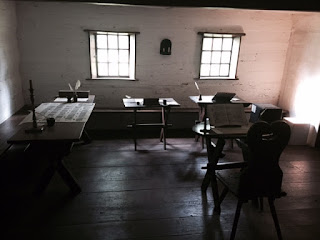
Fraktur_demo_Ephrata_Cloister
Examples of Fraktur and writing implements

Each member of the community was educated and learned to read and write. Many delved into the arts, contributing to many of the things for which Ephrata Cloister was known. Their German calligraphy, known as Frakturschriften, can be seen in many of their manuscripts. The iconic white robes donned by each member of the community were all made on site. The community also became extremely well known for its music; they wrote hundreds of hymns that became widely recognized. Perhaps the most significant part of their legacy is their printing. Ephrata Cloister had a large printing operation complete with its own paper mill, printing office and book bindery in which customers could choose what binding they wanted on their books. [Editor's note: ten copies of The Martyr's Mirror, an important religious text printed at Ephrata in the 18th century, are on exhibit in the Visitor Center through September.]

Physicians_House_and_Small_Bake_House
(center) Physician's House and Small Bake House

After our guided tour through some of the original remaining buildings and artifacts at Ephrata Cloister, we departed for the Cornwall Iron Furnace. The iron furnace at Cornwall is the only intact furnace of its kind in the Western Hemisphere, and in its heyday was self-sufficient. All of the resources, from the wood for charcoal to the iron ore, were gathered in the hills and surrounding areas of the furnace. Towns were built to provide housing and a sense of community for its workers.

Elements_of_iron_smelting
Elements needed for iron production: iron ore, charcoal, limestone

The furnace was established by Peter Grubb, who (with his father) immigrated from Cornwall, England, to Pennsylvania. A stone mason, Grubb recognized immediately the significance of the iron ore-rich hills, and by 1742 the furnace (named in honor of his home) had begun operations. After Grubb's death a decade later, Cornwall was passed on to his sons who continued to run the facility until around 1798, when the furnace was acquired by Robert Coleman. Coleman was extremely successful in the management of the furnace and quickly became one of the wealthiest men in the state. By the 1880s a newer and more efficient smelting process, fueled by anthracite coal, made the furnace in Cornwall obsolete. In 1883, after nearly a century and a half of productivity, the Cornwall Iron Furnace ceased operations.
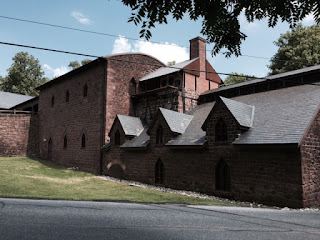
Cornwall_Iron_Furnace
Cornwall Iron Furmace

My time with PHMC over the course of the summer has been an enriching and rewarding experience. It opened my eyes to the plethora of locations throughout the state where our past is preserved so that anyone can glimpse first-hand our history, such as at Ephrata and Cornwall. Furthermore, my time here as an intern has bolstered my appreciation of our past; it has broadened my horizons and presented a multitude of new avenues from which to approach the study and preservation of history.